
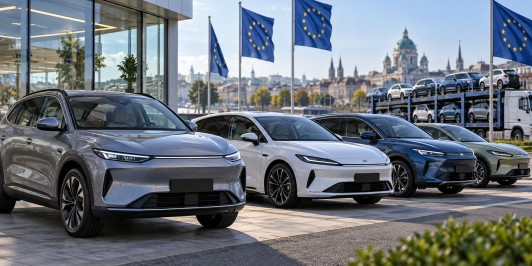
The rapid increase in sales of Chinese-made hybrid cars in the European Union is intensifying competition for European automakers and prompting policy discussions in Brussels. With hybrids now accounting for nearly 37% of the EU car market, the influx of Chinese vehicles threatens to shift market dynamics and impact local manufacturers.
In a striking growth trajectory, sales of fully hybrid vehicles produced in China skyrocketed from 659 units in 2022 to 160,662 in the first seven months of 2026. Similarly, Chinese-made plug-in hybrids saw a sharp increase, rising from 56,706 units in 2022 to 217,764 this year. These figures underscore the burgeoning presence of Chinese automotive companies like BYD, Chery, and Leapmotor, with Geely leading as the largest Chinese automotive group in Europe.
The surge in hybrid vehicle sales followed the European Union’s 2024 implementation of anti-subsidy tariffs targeting Chinese electric vehicles, effectively exempting hybrids from these measures. This regulatory environment has facilitated the expansion of Chinese hybrids in the EU market, raising alarms about a growing trade imbalance and the potential erosion of the competitiveness of European carmakers.
Amid these developments, the European Commission has approached China, seeking a voluntary agreement to limit the export of hybrid vehicles to Europe. Should negotiations fail, the EU is contemplating safeguard measures, which could include the imposition of quotas to protect the domestic automotive industry.
BYD, one of the notable Chinese manufacturers, reported sales of approximately 177,000 vehicles in the EU, highlighting their strong year-on-year growth. Meanwhile, Geely sold around 205,000 vehicles in the first eight months of 2026. Despite the rise of Chinese vehicles, European manufacturers still hold the largest overall market share, but the landscape is rapidly evolving.
As the EU grapples with these challenges, the broader implications for the regional automotive sector remain a focal point of concern. The push to address the trade imbalance with China and safeguard local industry competitiveness underscores the complex interplay of global trade policies and market dynamics.