
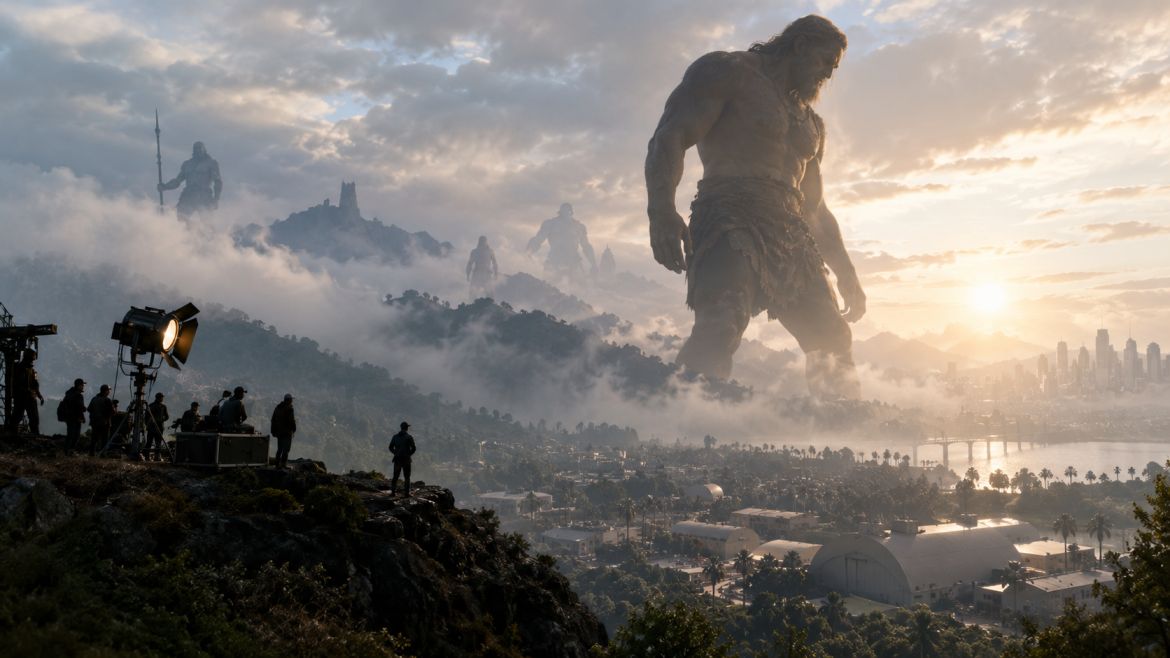
From legendary beasts and towering heroes to amiable giants and massive robots, the world of cinema has long been fascinated with the concept of size. This fascination has given rise to countless memorable giants throughout film history, each bringing their own unique charm to the screen. Among these cinematic titans, some have become iconic figures, such as Talos from “Jason and the Argonauts” (1963). This bronze giant, brought to life through Ray Harryhausen’s stop-motion magic, stands as a testament to the art of practical visual effects, creating a scene of awe and suspense as he turns from a lifeless statue to a fearsome guardian.
Another giant that has left a lasting impression is André the Giant’s portrayal of Fezzik in “The Princess Bride” (1987). Unlike typical visual effects, Fezzik’s character is defined by André’s natural stature, bringing warmth and humor to the role. Similarly, the towering genie in “The Thief of Bagdad” (1940), played by Rex Ingram, showcases the ambition of visual effects in early cinema, setting a high standard for future fantasy films. In more recent times, films like “The Green Knight” (2021) and “The Odyssey” (2026) have continued to explore this theme, with David Lowery’s Arthurian epic featuring enigmatic, towering figures that blur the lines between myth and reality, and Christopher Nolan’s adaptation of Homer’s work emphasizing the physical presence and isolation of the Cyclops Polyphemus.
In Steven Spielberg’s “The BFG” (2016), Mark Rylance embodies the Big Friendly Giant through motion capture, introducing younger audiences to a world where giant creatures roam. Meanwhile, “Jack the Giant Slayer” (2013) blends fairytale and fantasy as Nicholas Hoult’s character, Jack, finds himself in a battle with giants. Other films like “The Hobbit: An Unexpected Journey” (2012) and “Harry Potter and the Goblet of Fire” (2005) present encounters with massive beings that add depth and scale to their respective fantastical worlds.
Cinema has also explored the psychological and societal implications of gigantism, as seen in “The Amazing Colossal Man” (1957) and “Attack of the 50ft Woman” (1958). These films, rooted in the atomic-age fears of the 1950s, depict characters whose extraordinary growth leads to both personal and public turmoil. In contrast, more grounded portrayals, such as Karl the Giant in Tim Burton’s “Big Fish” (2003), emphasize the emotional and relational aspects of giants, making them more relatable to audiences.
From the whimsical to the terrifying, giants in cinema continue to captivate audiences with their sheer scale and the diverse stories they tell. Whether through groundbreaking effects or the natural presence of larger-than-life actors, these giants remain an integral part of the cinematic tapestry, offering viewers a glimpse into worlds where size truly matters.