
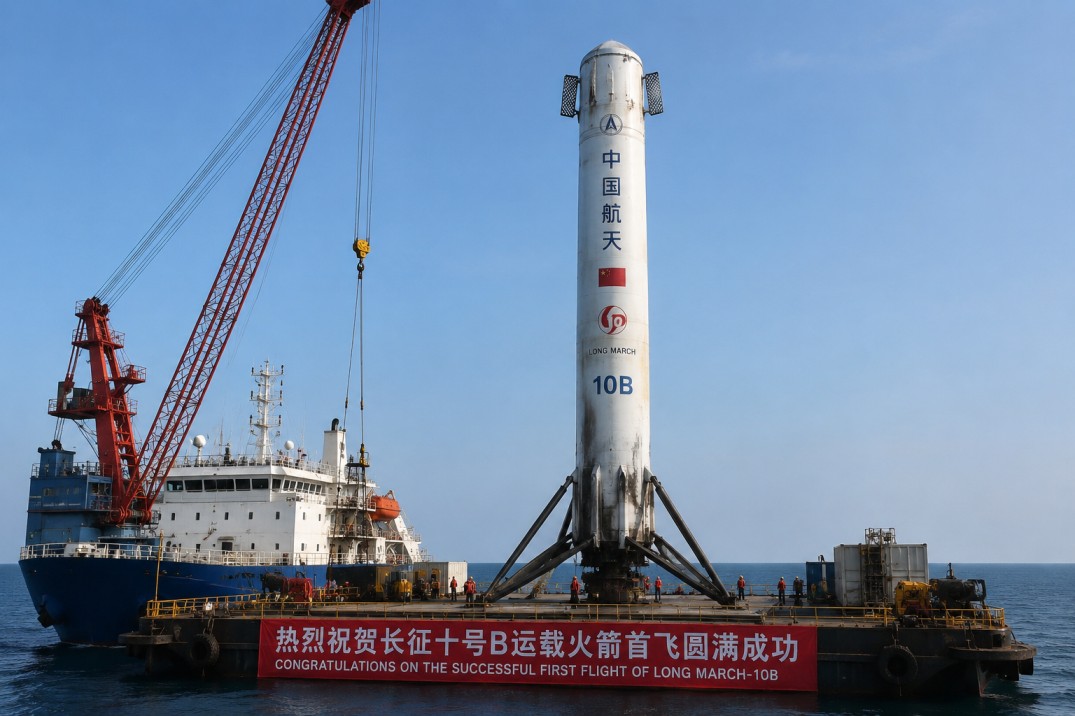
In a significant breakthrough for China’s space ambitions, the nation has successfully retrieved its Long March 10B rocket after its inaugural orbital mission. This achievement positions China as the second country, following the United States, to demonstrate reliable reusable orbital rocket technology, marking a pivotal moment in its aerospace advancements.
The Long March 10B, standing at 63.6 meters tall, launched from the Hainan International Commercial Aerospace Launch Center. The rocket’s journey was powered by seven engines fueled by liquid oxygen and kerosene. Upon reaching a certain altitude, the first stage separated, allowing the second stage, equipped with a liquid oxygen-methane engine, to continue the mission. This stage successfully placed a satellite into its intended orbit, showcasing the mission’s success.
An innovative aspect of this mission was the use of a wire arrestment recovery system, marking the first time this method has been successfully employed for the recovery of an orbital-class rocket. This technological advancement underscores China’s growing prowess in reusable launch technology, a critical component of its expanding space program.
The successful recovery of the Long March 10B not only highlights China’s technological capabilities but also signifies a step forward in reducing the costs associated with space travel, by reusing components of the launch vehicles. This development is expected to bolster China’s position in the global space race, as it continues to invest in and expand its space exploration initiatives.
As China advances in its reusable rocket technologies, this milestone is likely to pave the way for more frequent and cost-effective space missions in the future. The achievement reflects the country’s commitment to becoming a leading player in the realm of space exploration and technology.