
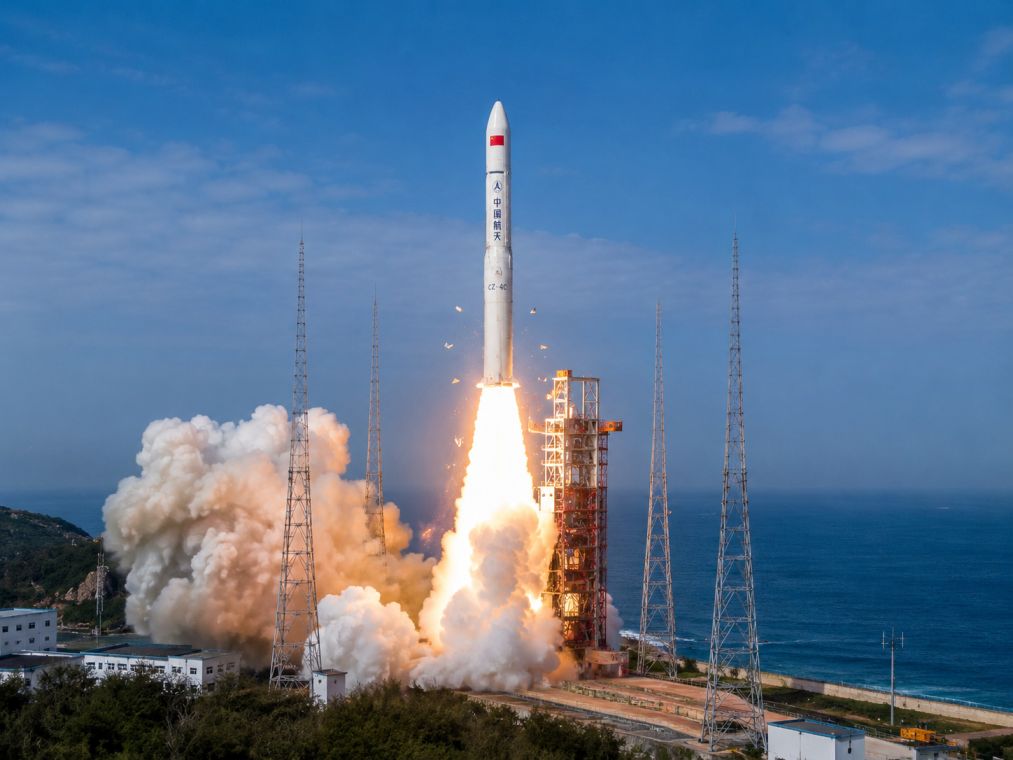
China has significantly boosted its ocean observation and environmental monitoring capabilities with the successful launch of the Haiyang-2E (HY-2E) marine satellite. This satellite was sent into orbit aboard a Long March 4B rocket, which took off from the Jiuquan Satellite Launch Center in northwest China at precisely 7:46 a.m. Beijing time on Thursday. This mission marks the 654th successful launch for the Long March rocket series.
Created by the China Academy of Space Technology (CAST), the HY-2E satellite is the latest installment in China’s Haiyang-2 series, the nation’s pioneering satellite network focused on observing the marine environment. The newly launched HY-2E will replace the HY-2B satellite, which has been operational since 2018, while continuing to work in conjunction with the HY-2C and HY-2D satellites. Together, these satellites form a constellation that delivers continuous data essential for marine observation and forecasting services.
Equipped with four cutting-edge microwave remote sensing instruments, the HY-2E satellite is poised to gather comprehensive data on sea surface conditions. Its capabilities include monitoring sea surface height, wave height, wind fields, and sea surface temperature. This information is crucial for marine weather forecasting, climate research, and studying phenomena like El Niño. Scientists anticipate that the satellite will significantly enhance the precision and reliability of ocean-related data collection.
Over the last ten years, the Haiyang-2 satellite program has been instrumental in areas such as disaster prevention, maritime safety, and scientific inquiry. The data provided by these satellites has been vital for tracking typhoons, supporting tsunami early warning systems, and refining global numerical weather prediction models. Additionally, their insights have been invaluable for marine resource management and national maritime security.
Beyond its contributions to weather and climate science, the Haiyang-2 series offers tangible benefits for the fishing and shipping industries. Information on ocean currents, winds, and waves aids in locating fruitful fishing areas, enabling vessels to operate more effectively and cut costs. Since the HY-2B launch, the inclusion of an Automatic Identification System (AIS) has also allowed for the continuous tracking of vessel positions, speeds, and identification details, thereby enhancing navigation safety on busy maritime routes.