
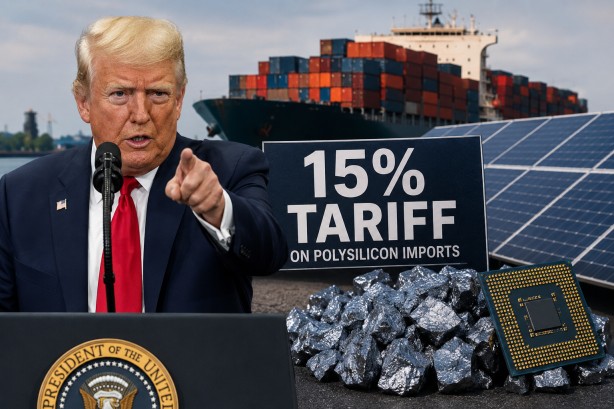
In a move aimed at bolstering domestic industries, US President Donald Trump has announced the imposition of a 15% tariff on imported goods manufactured with polysilicon, a crucial component in both semiconductor and solar panel production. This policy, set to be implemented on December 4, seeks to enhance US production capabilities and lessen dependency on China, the leading global supplier of polysilicon.
Polysilicon is an extremely pure form of silicon crucial for crafting semiconductors that drive artificial intelligence systems and data centers, as well as for making solar cells and panels. The newly introduced tariffs also establish minimum import prices, including $21 per kilogram for polysilicon, $100 per kilogram for polysilicon ingots and wafers, $0.22 per watt for solar cells, and $0.38 per watt for solar modules and panels.
The US administration has articulated that these measures are designed to enhance the commercial viability of domestic polysilicon production, while also reinforcing critical supply chains tied to both economic and national security. As part of this initiative, the government will have the capacity to offer incentives to companies that invest in domestic polysilicon manufacturing and related facilities. Currently, the US has two primary polysilicon production sites, operated by Hemlock Semiconductor in Michigan and Wacker Chemie in Tennessee.
China, which dominates the global production of polysilicon, has criticized the tariff, accusing the US of exploiting national security concerns to limit Chinese commerce. Chinese officials warn that this uptick in protectionism could lead to disruptions in trade between the two economic powerhouses. Meanwhile, China continues to experience robust growth in its exports, notably in the electronics and artificial intelligence sectors, as well as other high-value manufacturing industries.