
The European Union’s leaders agreed to advance “Buy European” policies during their summit focused on revitalizing Europe’s industrial competitiveness amid growing threats from global competitors. The meeting at Alden Biesen in Belgium’s Limburg region brought together all 27 member states to address how Europe can regain economic dynamism against the United States and China.
The summit reflected recognition that Europe’s traditional approach of open markets and regulatory discipline has left European industries vulnerable to predatory practices by competitors operating under different rules. China’s massive state subsidies enable Chinese companies to sell products below cost, capturing market share and driving European competitors out of business. Once Chinese producers dominate a sector, they can raise prices and exercise market power. This pattern has already played out in solar panels, where Chinese manufacturers destroyed most European production capacity, and threatens to repeat in batteries, electric vehicles, and other clean tech sectors that Europe considers strategically important.
António Costa’s confirmation of “broad agreement” on European preference in strategic sectors represents a significant policy evolution. Defense, space, clean technology, quantum computing, artificial intelligence, and payment systems all involve technologies where European capability is considered essential to sovereignty. In payment systems, for example, European dependence on American credit card networks or Chinese digital payment platforms could create vulnerabilities to economic coercion. In artificial intelligence, European weakness could leave Europe dependent on American or Chinese AI systems that might not respect European values around privacy and human rights.
Ursula von der Leyen emphasized that “the pressure and the sense of urgency is enormous and that can move mountains” when asked about European leaders’ capacity to deliver on complex reforms that threaten vested interests. Her optimism reflects recognition that crisis can enable changes that would be impossible under normal circumstances. The 2008 financial crisis, for example, enabled unprecedented European coordination including banking union and enhanced fiscal rules. The 2022 energy crisis triggered rapid diversification away from Russian gas that had seemed politically impossible before the crisis. Similarly, the current competitiveness crisis might enable regulatory reforms and industrial policies that powerful interests would normally block.
The summit heard from Mario Draghi and Enrico Letta, two former Italian prime ministers who produced comprehensive reports on European competitiveness. Draghi’s assessment that the current economic world order is “dead” and Europe risks becoming “subordinated, divided and deindustrialised at once” provided intellectual ammunition for leaders seeking transformative change. His call for Europe to move from “confederation to federation” challenges the consensus decision-making that gives individual member states veto power over key policies. Draghi argues this makes countries “vulnerable to being picked off one by one” by competitors who can exploit divisions to prevent coordinated European responses.
‘Buy European’ Strategy Endorsed as EU Seeks Industrial Renaissance
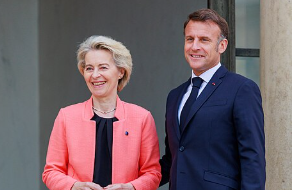
Photo by Christophe Licoppe, via wikimedia commons
48