
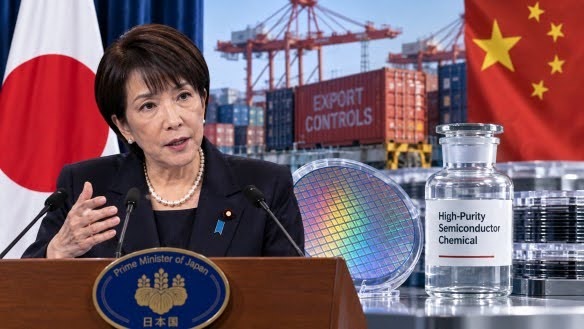
Japan has lodged a protest against China’s recent imposition of stringent export restrictions on dichlorosilane (DCS), a chemical crucial to semiconductor manufacturing. The Japanese government is currently evaluating the potential repercussions on its domestic companies, including major exporters such as Shin-Etsu Chemical and Denal Silane. Under the new rules, Chinese importers are required to make cash deposits of up to 99.2% for DCS imported from Japan, a move that has raised concerns in Tokyo.
These provisional restrictions follow an anti-dumping investigation by China, which allegedly found that Japanese exports of DCS were detrimental to its local industry. The investigation’s final verdict is still pending, but Japan has urged China to avoid implementing measures that could disproportionately harm Japanese businesses. Tokyo has also indicated that it might consider necessary actions should the situation warrant them.
This development occurs against a backdrop of increasingly strained relations between China and Japan, partly due to Japan’s stance on Taiwan. In addition to the DCS restrictions, Beijing has enacted other trade and export limitations targeting Japanese firms and items with potential military uses.
As a critical component in the production of semiconductors, DCS is utilized for creating ultra-thin silicon layers on computer chips. Given Japan’s position as a leading global supplier of ultrapure DCS, the new restrictions are poised to have a substantial impact on the semiconductor supply chain, an industry already grappling with various challenges.