
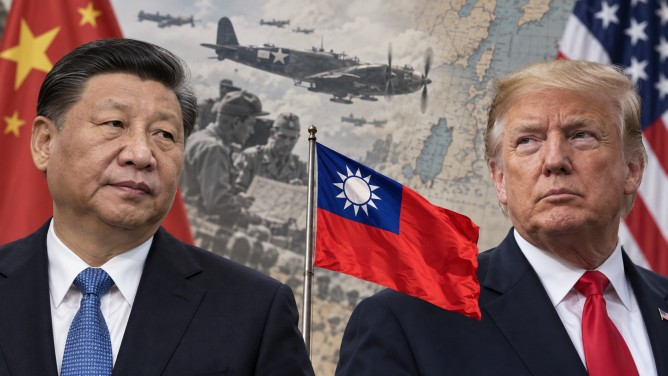
Taiwan is grappling with renewed debate over its World War II history following recent comments by U.S. President Donald Trump and Chinese President Xi Jinping highlighting historical cooperation between the United States and China during the war. This discourse arises from a meeting where Trump praised China’s alliance with the U.S. against Japan, specifically mentioning the Flying Tigers, an American military unit that supported China during the conflict. Xi echoed this sentiment, recalling the countries’ joint efforts against Japanese forces.
The comments have sparked concern in Taiwan, where officials assert that the China allied with the U.S. during World War II was the Republic of China (ROC), which governed mainland China at the time. After losing the Chinese civil war in 1949, the ROC relocated to Taiwan, where it remains the governing authority. Taiwanese officials have accused Beijing of manipulating wartime history to bolster its own historical narrative, while opposition figures criticize the Taiwanese government for seemingly distancing itself from the ROC’s pre-1949 history.
This issue underscores the broader historical dispute between Beijing and Taipei regarding the legacy of wartime China. Analysts suggest that the renewed focus on World War II cooperation could further complicate Taiwan’s efforts to define its historical and political identity, particularly in the context of maintaining strong ties with the United States.
Beijing’s use of wartime history is seen by some in Taiwan as an attempt to strengthen its claims over the island by emphasizing continuity with the ROC’s wartime role. This strategy is perceived as part of China’s broader efforts to assert its territorial claims and influence over Taiwan, which it considers a breakaway province.
The historical narrative of World War II cooperation is not just a matter of historiography but has practical implications for Taiwan’s current political positioning. The island continues to navigate its relationship with both China and its key ally, the United States, amid these historical tensions. As both sides present their interpretations of the past, Taiwan faces the challenge of defining its identity in a way that respects its historical roots while addressing contemporary geopolitical realities.