
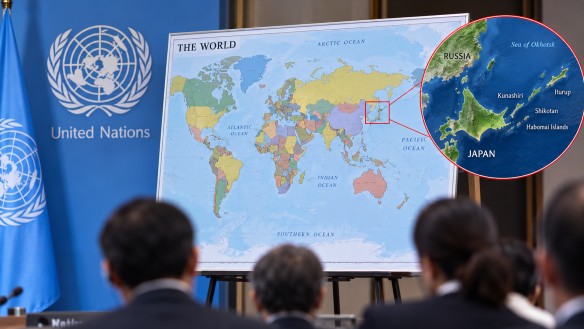
A newly introduced world map utilizing the Equal Earth projection has ignited a dispute over territorial representation, with Japan voicing objections regarding the portrayal of the Kuril Islands. This projection aims to depict the relative sizes of continents more accurately compared to the traditional Mercator projection, leading to a noticeable change in how continents appear; Africa looks much larger, while Europe and North America appear smaller than usual.
Japan’s concern centers on the depiction of the Kuril Islands, which it calls the Northern Territories. The islands are shown in the same color as Russia, potentially implying Russian ownership, which Japan disputes. This chain of islands stretches between Japan’s northern region and Russia’s Kamchatka Peninsula, and the territorial dispute over these islands has been a longstanding issue between the two nations.
The controversy underscores the impact of map design on perceptions of borders and territorial ownership. Maps are not just tools for navigation; they carry cultural and political significance, especially in regions with contested boundaries. Different mapping systems can alter the visual appearance of countries and continents without affecting their actual size or location.
The Equal Earth projection was created to provide a more balanced representation of the world’s land areas. Unlike the Mercator projection, which distorts the size of regions near the poles, Equal Earth maintains the proportional size of continents while displaying the entire globe on a single map. This new projection offers geography enthusiasts and travelers an alternative view of the world, illustrating how the appearance of familiar locations can vary dramatically depending on the mapping approach used.
This ongoing debate over the new map highlights the complex role maps play in shaping our understanding of geography and politics. The colors, borders, and labels used in maps can convey significant meanings, influencing perceptions in regions where territorial disputes remain unresolved.