
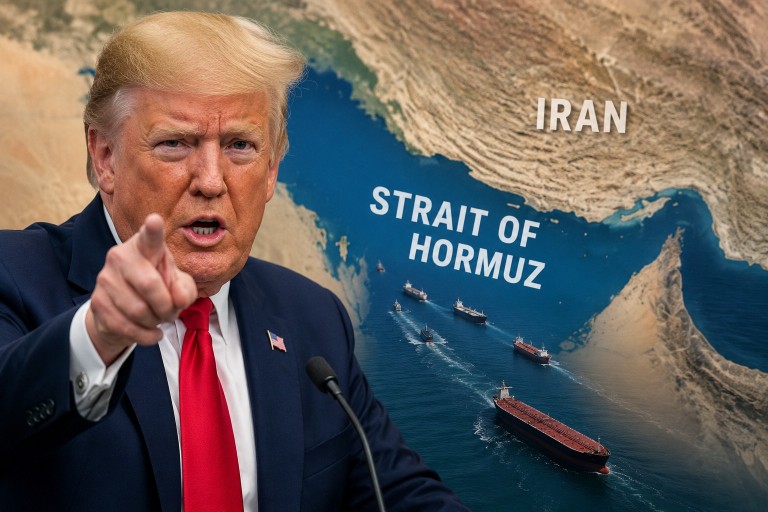
President Donald Trump has issued a warning regarding the Strait of Hormuz, suggesting the United States might declare it as American territory amid ongoing tensions with Iran. Speaking in New York on Friday, Trump stated that the U.S. could make this declaration “pretty soon” following what he described as a defeat of Iran. He further asserted that the U.S. effectively controls this crucial waterway through a blockade.
The Strait of Hormuz is a vital shipping lane, with nearly 20% of global seaborne oil shipments traversing it. Situated between Iran and Oman, it has seen significant disruption due to military operations by the U.S. and Israel against Iran. The strategic importance of this passageway makes any potential changes in its administration significant on a global scale. Despite Trump’s remarks, it remains uncertain if this signifies an official shift in U.S. policy or serves merely as a political statement.
In response, Iran has dismissed the threat, with Deputy Foreign Minister Kazem Gharibabadi declaring that Tehran will not succumb to U.S. pressure. He emphasized that decisions regarding the strait’s status remain within Iran’s jurisdiction. Additionally, Iranian Foreign Minister Abbas Araqchi clarified that Tehran has not opted to resume negotiations with the U.S., noting that ongoing communications via Qatar and Pakistan do not amount to formal discussions.
Iran has set forth several demands before consenting to the resumption of shipping through the strait. These include compensation for wartime damages, lifting of sanctions, and the release of frozen Iranian assets. The conflict and resulting shipping disruptions have led to higher fuel prices globally, further straining consumers. President Trump defended the increased prices, asserting that they are a necessary measure to prevent Iran from developing nuclear weapons.
The ongoing deadlock over the Strait of Hormuz has heightened concerns about the stability of global energy supplies and the broader economic ramifications of the conflict. As tensions persist, the international community continues to watch closely for any developments that might alter the current situation.